05 Frameworks &
Sensory experiences
This week was mostly workshops, learning about research methodologies I might or might not use. Interview workshop with Yasser, case studies workshop with Vikas, and a talk by Ashley from Feelers about their interdisciplinary research practice.
Week-five
15~ 21, Sep, 2025Journal-by
Choi YerinKeywords
- Case-studies
- frameworks
- Simplicity
- Sensory-exploration
- Loading-animations
Workshop Week
The interview workshop was useful for understanding the rigor required, but honestly I'm questioning whether I need interviews at all. Yasser warned against being "too greedy" with methods. Right now I'm already doing computational prototyping, case studies, and user evaluation. Adding formal interviews might be overextending.
The case studies workshop with Vikas was more directly relevant. He emphasized that case studies aren't a method but an approach, which is a way of learning from existing examples to inform your own work.
Case Study Approach:
Email Exchange with Vikas
After the workshop, I took a chance to email Vikas to clarify my case study boundaries and get feedback on my approach.
Vikas
How are you distinguishing "brand interactions" from the larger set of interactions?, "distinctive interaction languages" — how is this determined? What's your criteria for selecting brands to analyze?
Me
Valid concerns. I've been assuming I'd recognize distinctive interactions when I see them, but I need more systematic selection criteria.
Vikas's response raised an important question I hadn't fully addressed: Do I have reliable criteria, or am I just identifying them intuitively? This is something I need to develop more rigorously. What makes an interaction "branded" versus just well-designed? I can sense the difference when I experience it, but I need clearer criteria for analysis.
Analytical Framework:
Norman and Verplank
For analyzing case studies more systematically, I'm combining two frameworks for interactions:
Norman's Action Cycle (seven stages of interaction):
Goal formation (what do I want?)
Planning (what actions needed?)
Specifying (how do I do it?)
Performing (executing)
Perceiving (what happened?)
Interpreting (what does it mean?)
Evaluating (did it work?)
Verplank's Input/Output/Structure model:
Input: How does the brand "listen" to users? (response to touch, gesture patterns)
Output: How does the brand "speak" back? (animation style, feedback timing, haptic responses)
Structure: How does the brand organize interaction space? (navigation logic, hierarchy, flow)
This could help me map brand expression systematically rather than just intuitively identifying.
Research Progress
I've been working on making my research question clearer using the HMW formula:
Option 01:
"How might we develop systematic methods for interaction designers and practitioners to create branded interactions so that digital interfaces can express brand personality through user behavior patterns rather than just visual elements?"
Option 02:
"How might we use computation as a design research method for interaction designers and practitioners to investigate how interface behaviors can embody brand identity so that brands can be expressed through interactions rather than just visual elements?"
During consultation for RPO, I realized I'm using too many ambitious words like "provide new perspective," "provide both theoretical and practical insights." How do I know there isn't already research on this? I need to be more cautious and less presumptuous about contributions.
Also realized I'm inconsistent with terminology. Am I talking about brand "personality" or brand "identity"? Are they the same? Different? I've been using words interchangeably, assuming readers will understand, but I need to be more precise.
Updates on reading:
Computational Composites
I've been reading more about computational approaches, particularly Vallgårda and Redström's work on computational composites and I found some concepts that directly support my experiments.
Their key insight: computational composites can exist in multiple states (colors, shapes, positions). When conditions are met, a transition toward a new state begins. The computations enable controlled transitions between states.
If I connect them to my button experiments:
States: Button conditions (normal, hover, pressed, released)
Transitions: The animation between states
Control: The parameters (timing, easing, scale) that determine how transitions feel
The computer handles complex calculations internally, but users only see the result: "this button responds in an playful way" or "this feels like Duolingo." This theoretical framework validates using code as a research tool for systematically manipulating interaction parameters.
Experiments:
Physical Sensory Exploration
Following Andreas's "look beyond screen" challenge from last week, I actually did some tactile experiments. Touched different materials with different pressure levels and documented what I felt.
Key Observations:
Surface sensitivity: Smoother surfaces amplify tactile awareness—like how you can hear your heartbeat in a silent room. With no texture to distract, you feel subtle details more intensely.
Digital translation: Minimal visual noise makes subtle interaction feedback more noticeable. Clean interfaces where small movements have strong effects. Higher sensitivity to cursor/touch movements on visually "smoother" surfaces.
Depth/Resistance relationship: The softer the material, the deeper and slower you can press. Soft materials allow gradual pressure buildup.
Digital translation: Longer press duration could trigger deeper interaction states. Luxury brands might use slow-building, deep interaction patterns. Instead of binary on/off, map press duration to scale and depth.
Friction: Different materials resist movement differently. Some surfaces let your finger glide, others create drag.
Digital translation: Varying "drag" coefficients for different interface elements. Premium interactions might have more resistance (deliberate, considered). Playful ones might have less (fluid, easy). Different easing curves and momentum for scrolling, swiping, dragging.
This physical exploration gave me concrete parameters to explore computationally. It's not just abstract "make it feel premium"—it's specific qualities like resistance, depth, friction that can be translated into code parameters.
New Experiment Direction
Loading Animations
Q/W to change Speed
A/S to change Size
I started exploring loading animations in p5.js. Loadings are interesting because they add another layer of brand experience in waiting states between page or action transitions.
Airbnb
Breakthwrk
CRED
There are countless variations of loading animations. Some brands use illustrated animations (Airbnb, Duolingo with characters), but I'm focusing on shape-based ones such as circles, bars, spinners, for better analysis within structured frameworks I can manage.
Why loadings matter?
Me
They bridge the gap between user action and system response. They acknowledge something is happening while keeping users engaged. Good loading animations make delays feel shorter and less frustrating.
The motion should feel purposeful and reassuring, transforming idle time into a dynamic moment that communicates progress. It's not just "please wait," it's an expression of brand personality during a vulnerable moment when users might get impatient.
Next week I'll develop more refined loading prototypes with systematic parameter manipulations
Finding Existing Tools:
editable.gif
While searching for loading animation examples, I discovered editable.gif—a website where you can edit loading animations and export them as code, videos, or gifs. It has a library of editable loading animations you can customize and download.
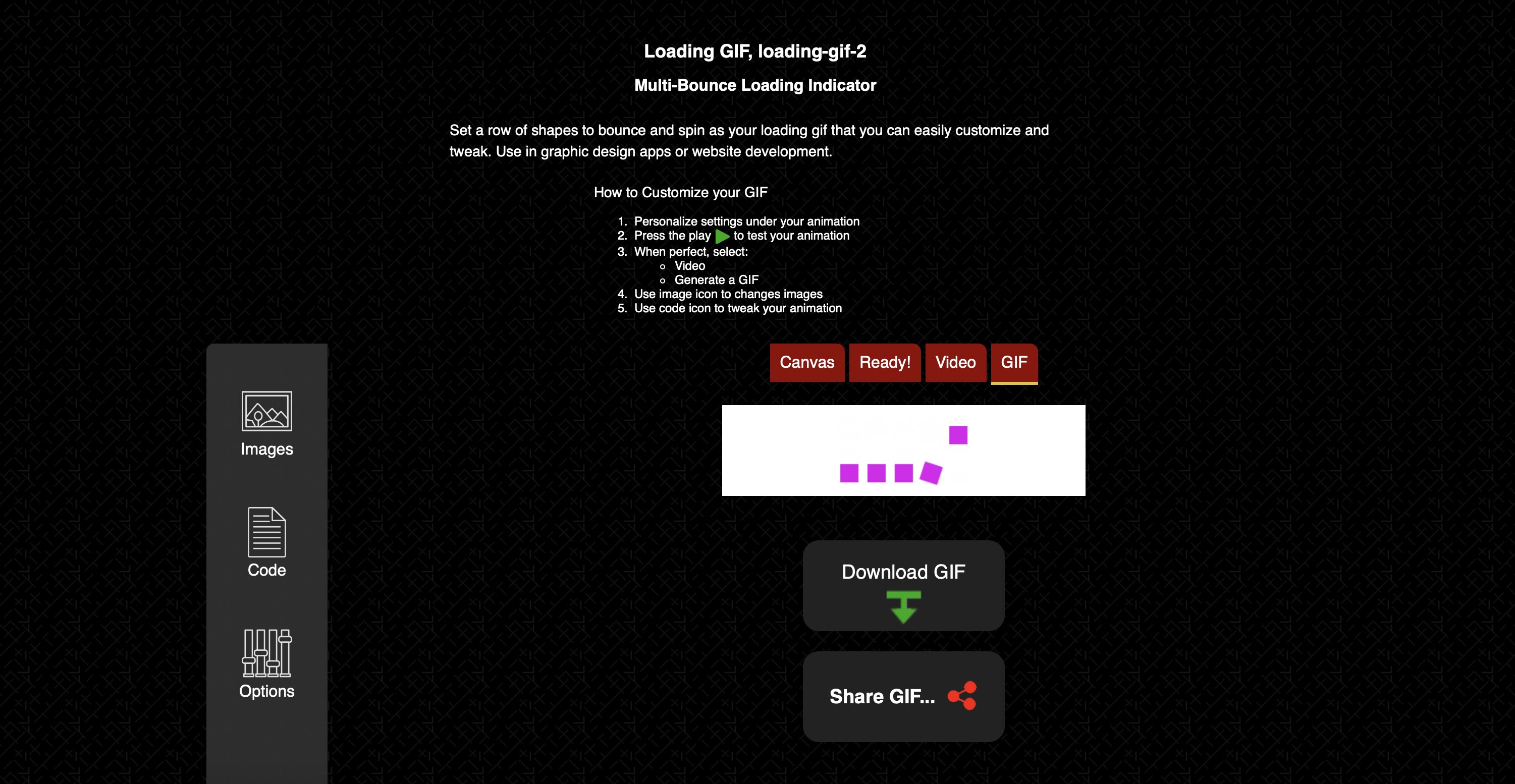
Screenshot of editable.gif Here
My first reaction was honestly discouraging. Someone already built a tool for creating and exporting loading animations. Isn't that part of what I'm trying to develop? But then I remembered Andreas's advice: “when you research more, you'll find similar work. Don't be discouraged—use it as a resource.” So why not? editable.gif solves a different problem than what I'm investigating.
Exported gif

I can also analyze their library to see what parameter ranges they offer. The tool's existence actually validates that there's demand for systematic ways to create and customize interaction animations. My research contributes by understanding why certain parameter choices create specific brand perceptions, not just providing another customization tool.
What I Need to Address
Selection criteria for case studies: Need to develop clearer criteria for what makes an interaction "distinctively branded".
Terminology consistency: Clarify whether I'm discussing brand personality, brand identity, or both and define the distinction.
RPO refinement: Revise the research proposal with clearer language, less ambitious claims, and more precise terminology.