15 Final Year
Overview
The focus of this week was the finalization of submission deliverables and the preparation for the Viva Voce presentation. Efforts were centered on refining the exhibition layout, completing the production of the physical Catalogue of Making, and updating the Atmost digital archive based on observations from Open Studios. The goal was to transition from a studio workspace into a purposeful presentation environment where the research artifacts are the primary focus.
Week-fifteen
20 ~ 26. April, 2026Journal-by
Choi YerinKeywords
- Viva-voice-setup
- Documentation
- Spatial-Hierarchy
- Reflection
Table Setup
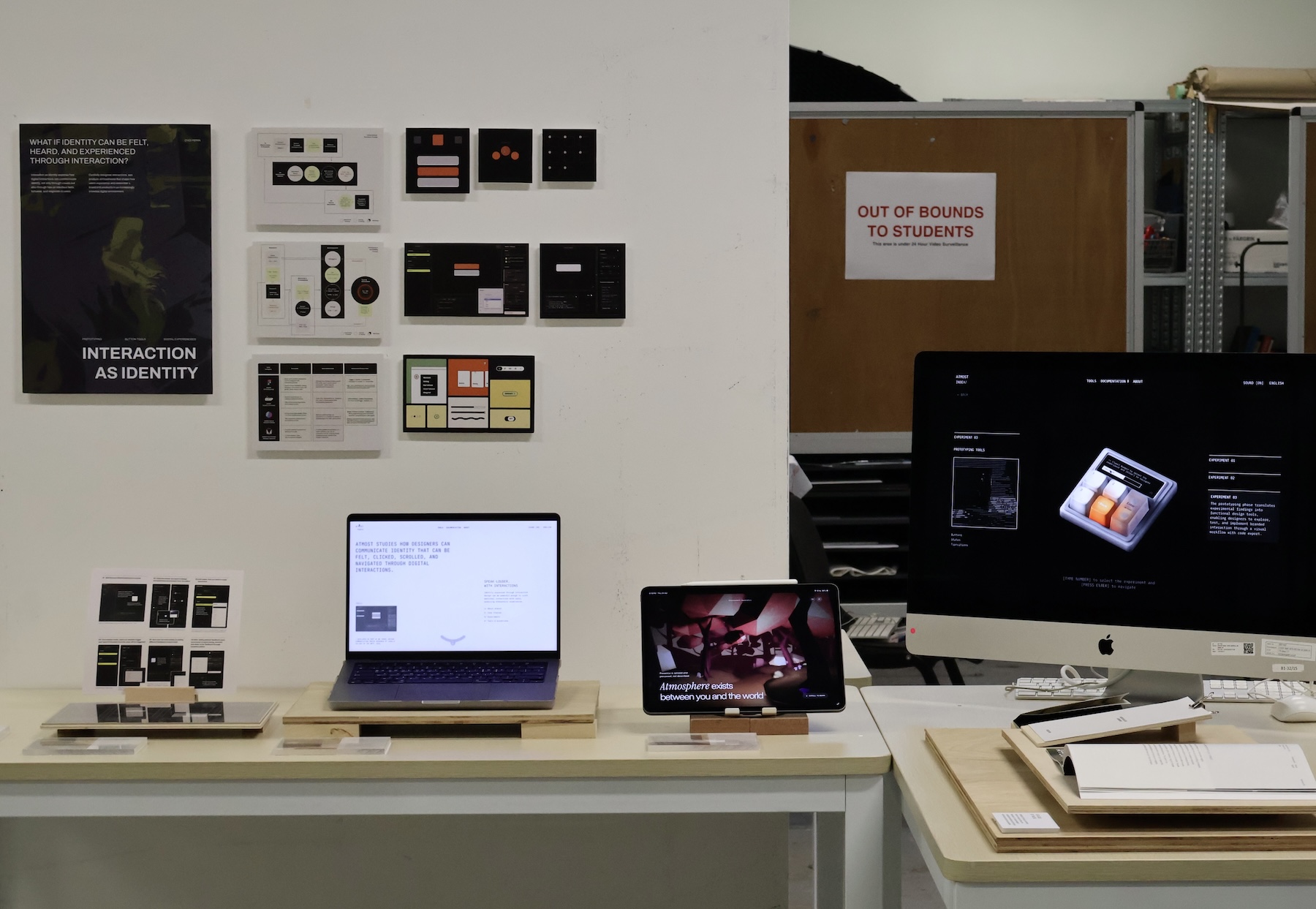
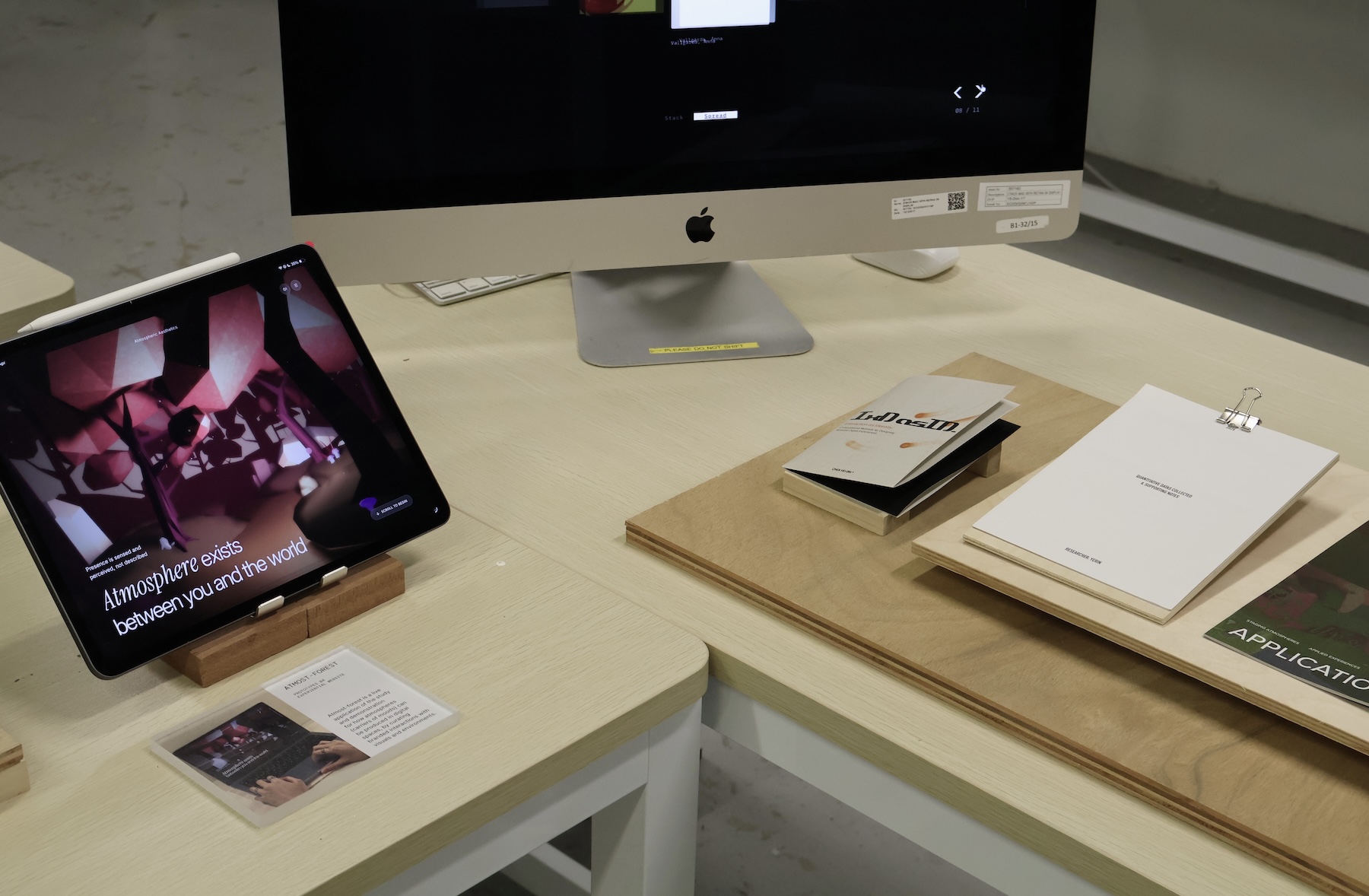
I reorganized the table setup for the Viva Voce presentation to prioritize the final artifacts over the development tools. While the iPad was used to demonstrate the button parameter lab earlier in Open Studios, I repurposed it for Atmost Forest utilizing the newly developed touch scroll functionality.
Setup Logic:
iMac: Looping video for overall web artefacts.
Laptop: Primary archive for Atmost research and case studies.
iPad: Immersive, hands-on experience of Atmost Forest.
Wall Partition: Initially, I included a variety of process visuals on the wall, but this was distracting. Since I wanted the focus to be on the table with screens more, I simplified the setup for the wall to only include specific diagrams and visuals for the methodology (computational experiments and tool building). This allows the wall to function as a visual aid during the presentation rather than a decorative background.
Usability Refinements
Observations from Open Studios revealed specific user behaviors on the experiments landing page. Visitors consistently interacted with the most vibrant orange button on the keyboard visual, regardless of its function.
> Changed flow of Experiements page
To increase a usability aligning with this behavioral pattern, I changed the orange button's function to open the latest and most significant experiments: the Playful Palette and Atmost Forest. This adjustment utilizes visual hierarchy to guide users toward the most recent work, making the resource archive more intuitive.
Documentation & Presentation
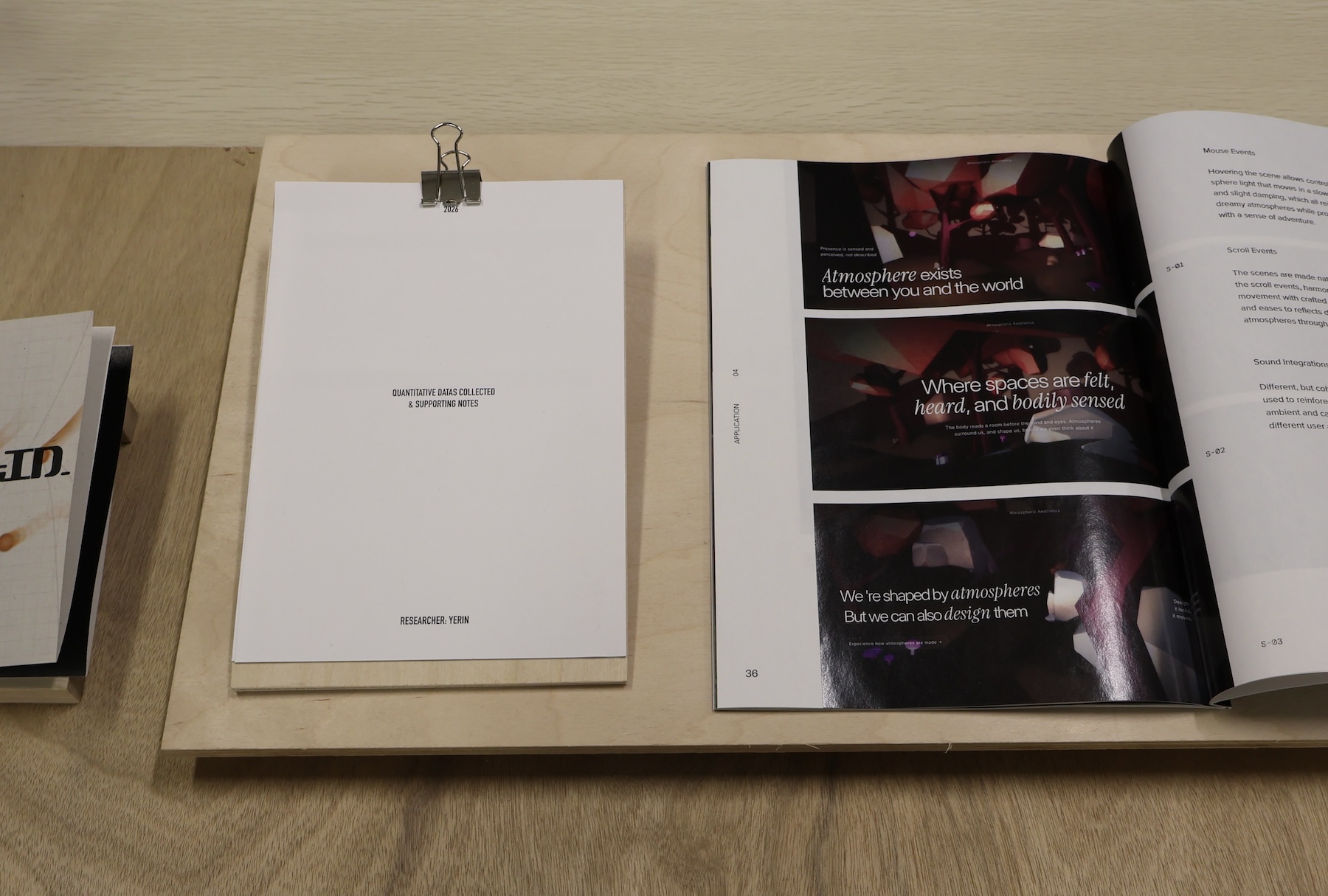
Opened Catalogue of Making with other prints (brochure, user test results)
Catalogue of Making
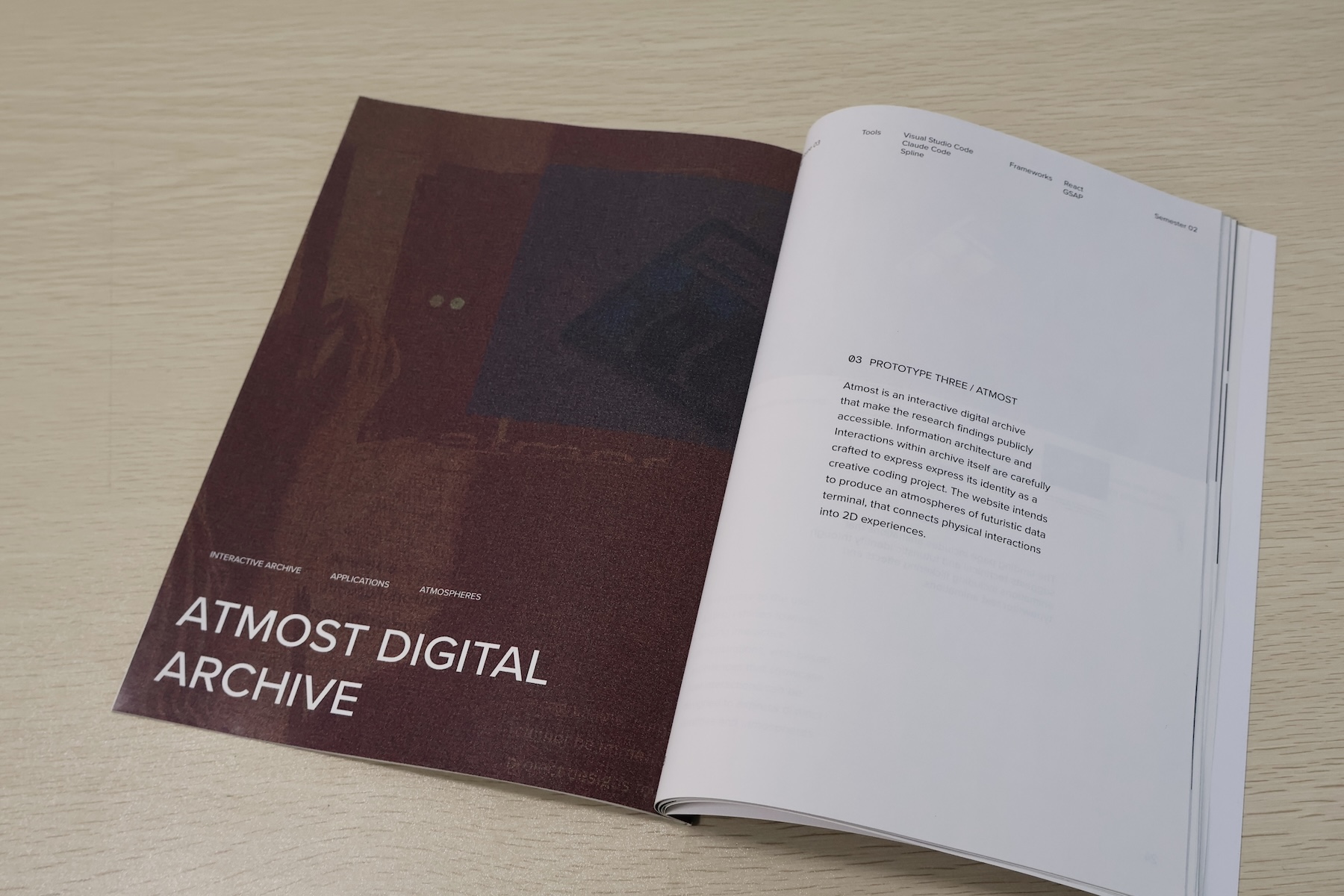
I redesigned the physical catalogue and reprinted to improve its presence on the table. The initial print on white matte paper resulted in colors that felt too bright and unnatural due to the shift from RGB screenshots (the visual nature of my prototypes) to CMYK printing.
Catalogue of Making
Material Choices:
Paper Selection: A thinner, maple white (slightly yellow) paper was chosen for the interior. The warm undertone of the paper helps the CMYK colors appear more natural and closer to the original digital visuals.
Ergonomics: The use of thinner paper allows the book to lay flat when opened on the table. This facilitates a better scanning experience for viewers who may not wish to pick up the book.
Cover Texture: A thicker, textured paper was used for the cover. This provides a tactile contrast to the interior pages and ensures the book remains protected while feeling premium to the touch.
Contests: Updated documentation for Atmost Forest and a QR code for direct mobile access were integrated into the final layout.
Presentation Deck
Overview Reflection
Personal Growth and Technical Friction
Looking back at this two-semester journey, I am honestly surprised by how far I have come from that first abstract idea. When I started, I felt a lot of excitement, but I also felt paralyzed because I didn't know how to bridge the gap between my theories on atmosphere and actual technical execution. I remember the frustration of having a vision that I couldn't yet build.
Throughout this year, I realized that my fluency in Figma was not enough. Figma is excellent for visual layouts, but it doesn't allow me to truly feel an interaction or test the rhythm of a scroll. I had to push myself into the friction of front-end development, motion, and 3D tools, which was often stressful and full of mistakes. However, I learned that progress only happens when I stop overthinking and start making. Every week, even when I felt I was failing, I forced myself to produce something tangible, and that persistent making is what finally made the concept straightforward.
Vibe Coding
I also have to acknowledge how much my process has changed with AI. Using Claude for vibe coding felt less like using a tool and more like working with a coworker. It allowed me to challenge technical problems that I previously would have thought were impossible for me to solve. It has fundamentally changed my perspective on the industry. I now see that as technical barriers fall, my value as a designer lies in my visual judgment and my ability to craft a specific quality of experience.
Future Passion
Through the research and making process, I’ve found my passion in experimental and the interactive interface design. I want to continue exploring how to put my own style and Böhme’s theories into product design, even if it goes against the grain.
Acknowledgments
Last but not least, I am deeply thankful for the feedback from my supervisor, Andreas. His critiques were often harsh and forced me to defend my choices, but they were exactly what I needed. He pushed me to stop staying still and kept me evolving. Looking back at the table setup and the final catalogue, the work feels rewarding because I didn't just settle for what I had but kept challenging myself.
Next Steps
The remaining tasks include finalizing the presentation script for the Viva Voce and practicing the delivery. Additionally, the exhibition setup will be further refined for the Lasalle Show to ensure the experience is fully self-explanatory for audiences who will view the work without a live presenter.